
What powers China's economic transformation?
Xinhua
03 Jul 2026
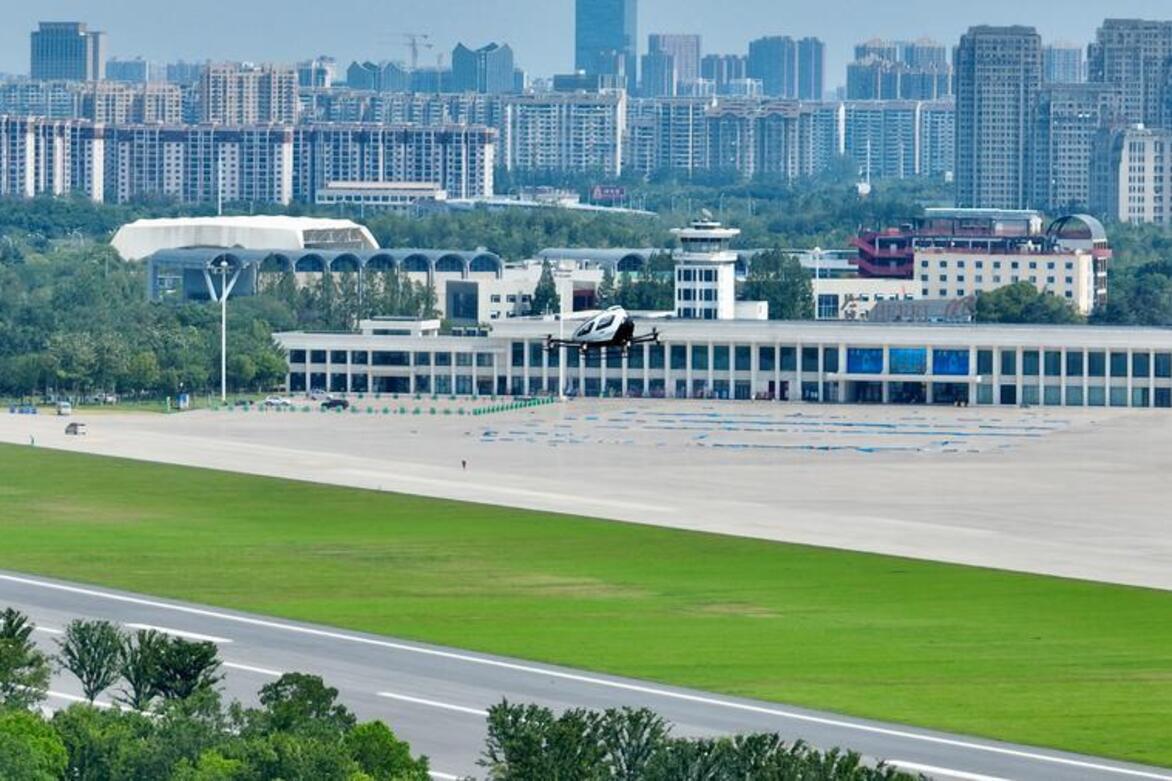
HEFEI, July 3 (Xinhua) -- Aircraft are taking off again from the site of an abandoned airport in Hefei, east China's Anhui Province, but this time there are no departure gates or boarding calls.
The old runways now cut through Luogang Park, a vast urban space where autonomous buses carry visitors, unmanned vending vehicles stop when hailed, drones fly overhead, and unmanned electric vertical take-off and landing (eVTOL) aircraft lift off from the site where civil aviation planes once took off.
The scene captures a broader transformation taking place in Hefei, once a modest inland provincial capital with no seaport, no major river port, no coal or iron base, and little industrial heritage. The city is now a comprehensive national science center and a base for new-energy vehicles, advanced displays, integrated circuits, photovoltaics, quantum technology and fusion research.
As China marks the 105th anniversary of the founding of the Communist Party of China and enters the 15th Five-Year Plan period (2026-2030), Hefei offers one answer to a broader question: how do long-term national goals breed laboratories, factories, supply chains and new sources of growth?
FROM SCIENCE TO INDUSTRY
Since reform and opening-up, China has grown into the world's second-largest economy, built the world's most complete industrial system and lifted hundreds of millions of people out of poverty -- achievements often described as the outcomes of rapid growth and long-term stability.
The scale remains evident. In 2025, China's GDP reached nearly 140.19 trillion yuan (about 20.6 trillion U.S. dollars), manufacturing value added stood at 34.7 trillion yuan, and output and sales of new-energy vehicles both exceeded 16 million units.
The next stage is focused less on sheer scale and more on the quality of growth. Under the 15th Five-Year Plan, China has put the development of new quality productive forces tailored to local conditions in a more prominent position, with technological innovation as the guide, the real economy as the foundation, and the national innovation system as support.
A People's Daily article on the development of innovation centers noted that achieving high-level sci-tech self-reliance depends on the coordinated development of education, science, and talent, along with investment in people, institutions, and physical assets.
Hefei demonstrates how national strategy can take on a local form. The University of Science and Technology of China, founded by the Chinese Academy of Sciences in Beijing, moved to the city in 1970, giving Hefei an early research base. Hefei further turned to link research with factories, suppliers, capital, market demand, and a willingness to nurture long-cycle technologies.
In 2005, Hefei put forward an industry-first development strategy. In about two decades, it has built major clusters in new-energy vehicles, photovoltaics, displays, integrated circuits and home appliances. The path was tested by high-stakes choices: backing the sixth-generation production line of BOE Technology Group Co., Ltd. in 2008, supporting ChangXin Memory Technologies in 2016, and stepping in for NIO in 2020 when the electric vehicle maker was under severe financial pressure.
The pattern was less a taste for risk than a method of turning national bottlenecks into local industrial platforms. Yu Zhaobing, deputy director of Hefei's development and reform commission, noted that while some cities catch a single industrial wave and then face stagnation, Hefei has achieved two decades of sustained growth thanks to its industrial promotion system.
The key, he added, is managing the relationship between government and market: local authorities should not replace market forces, but they can help provide what the market may not offer in the early stages -- from capital and talent to testing sites and supply chain links.
WHERE INNOVATION MEETS DEMAND
If the first step is choosing strategic directions, the much more challenging test is turning inventions into products. A prototype needs testing sites, early users, suppliers, financing and eventually market demand.
At the 2026 Summer Davos forum in Dalian, Gim Huay Neo, managing director of the World Economic Forum, said scaled innovation means bringing technological innovation into the economy and society so that it serves ordinary people and public interests. Participants also said innovation now requires systematic capacity that can be replicated and implemented.
After visits to Anhui and Zhejiang provinces, an All-China Federation of Industry and Commerce research group reached a similar conclusion: future industries require basic research, commercialization, open scenarios, and a combination of an efficient market and a well-functioning government.
Hefei is often called China's boldest "venture capital city." A more precise description is organized experimentation. Public capital has been leveraged to attract leading enterprises, close supply chain gaps, and support hard technologies, while market competition ultimately determines which companies succeed.
The city has also worked to open application scenarios, creating a city-level scenario company to help start-ups and research teams find what they often lack: real users, real sites and real demand. By the end of 2025, Hefei had released more than 1,400 scenario opportunities, which served more than 4,100 technology firms and helped more than 1,200 projects land.
Fang Xiaowei, founder and general manager of Hefei Guojing Instruments Technology, said his start-up began with little more than a technology idea and a team. Through technical matchmaking, Fang said, the company gradually understood customer and market needs, as well as the direction of its product development.
The 15th Five-Year Plan frames such efforts in broader terms, calling for deeper integration of sci-tech and industrial innovation, faster application and transformation of research results, and wider cultivation and opening of application scenarios. Such planning offers one window into China's institutional code: long-term priorities are translated into platforms, application scenarios and industrial chains, helping sci-tech advances translate into new quality productive forces.
SYSTEM BEHIND SEQUENCE
Hefei's story is local, but the pattern is national. A strategic direction becomes a local plan; the plan seeks funds, parks and scenarios; those instruments support projects; projects draw suppliers; and suppliers form industrial chains.
The sequence only works when priorities are stable enough for patient investment and flexible enough for readjustment. At the national level, that means aligning long-term goals with phased tasks, keeping strategic initiative and adapting methods as conditions change. In practice, it requires consistent planning, strong execution, and the ability to course-correct when needed.
Foreign observers have also commented on these less visible mechanisms. Sabino Vaca Narvaja, former Argentine ambassador to China, noted that global discussions about China often focus on high-speed railways, 5G networks, and new-energy vehicles. However, he is more interested in the mechanisms for training, assessing, and motivating officials.
Earlier this year, China launched a Party-wide study and education program to guide officials toward establishing and practicing a correct understanding of what it means to perform well, emphasizing concrete work and tangible results. Vaca Narvaja cited this as a window into China's governance logic: officials, he wrote, should not be judged by how many meetings they hold or documents they issue, but by whether they solve real problems for the people.
For Vaca Narvaja, effective public policy depends on both top-level design and grassroots implementation, while Felix Valdivieso, chairman of IE University's China Observatory in Spain, pointed out that China's five-year plans are cross-cycle strategic frameworks that provide both direction and practical tools.
Such observations add depth to Hefei's experience. The city's rise is not due to a single investment or a fleeting industrial boom, but to a sequence that connects scientific resources with industrial policy, public capital with market competition, and long-term goals with practical platforms.
At Luogang Park, the aircraft soaring above offers a striking image. But the deeper story unfolds on the ground, where engineers, entrepreneurs, investors, researchers, and public servants are working together to build new national advantages where few once seemed obvious.